

Site Search
Search within product
No.713 Published 2019 (R1) .08/09
Click here for PDF version
§冠水の時期と時間ならびに湛水後の液肥かん注処理がレタスの生育,収量に及ぼす影響
Hyogo Prefectural Agriculture, Forestry and Fisheries Technology Center
Awaji Agricultural Technology Center, Agriculture Department
主任研究員 中野 伸一
§ゴルフ場で起きているサッチの問題とCDU入り肥料の芝生サッチ分解効果試験
General Incorporated Foundation Kansai Green Research Institute
所長 森 将人
Time and duration of flooding as well as after flooding
液肥かん注処理がレタスの生育,収量に及ぼす影響
Hyogo Prefectural Agriculture, Forestry and Fisheries Technology Center
Awaji Agricultural Technology Center, Agriculture Department
主任研究員 中野 伸一
Introduction
In the cultivation of open field vegetables, heavy rainfall is a major factor that destabilizes the crop. In particular, it has been reported that in summer and fall plantings, the growing period often coincides with typhoons and long rains, resulting in catastrophic damage, a sharp decrease in shipping volume, and a sharp rise in prices, causing confusion in the market and problems.
In Hyogo Prefecture, damage to agricultural products caused by Typhoon No. 23 in October 2004 amounted to 3.2 billion yen, most of which was due to flooding of open-air vegetables after planting, resulting in damage of 1,028 ha and 2.75 billion yen. In addition to typhoons, the number of localized heavy rains, which are short duration heavy rains of 50 mm or more per hour, has been increasing over the past 40 years, and open field vegetables are more likely to encounter flooding damage.
Lettuce is widely cultivated in open fields from autumn to spring in this prefecture, taking advantage of the mild winter climate. When such fields are flooded, it is necessary to predict the degree of decrease in growth and yield after flooding depending on the timing and extent of flooding, and to determine whether or not cultivation should be continued.
そこで,本研究では,レタスの生育期において一時的な冠水を再現するため,プランターで栽培したレタスを水没させる実験を行い,
1)冠水の時期と時間の違いがその後の生育,収量,商品性に及ぼす影響の評価を行った。
また,2)湛水後の対策として,草勢回復を図るため尿素のかん注処理の検討
を行った。尿素は非電解質で分子量が小さく拡散性や浸透性が極めて高いこと,葉の表皮のクチクラ層からも容易に透過し葉の内部に入ることが報告されており,生産現場で実施しやすい事後対策とするため,圃場レベルで湛水処理を行い,収量の回復を図る利用方法を検討した。
2. Testing Method
Experiment 1: Effect of timing and duration of flooding on subsequent growth and yield
実験は兵庫県南あわじ市八木養宜中の淡路農業技術センター内の圃場で実施した。供試品種は,冠水被害の危険性が高い早生作型の慣行品種‘ハミングチャウ’(日本アグリス (株))を用い,2011年8月24日に,育苗培土(N:P2O5:K2O=150:1,500:150mg・L−1)を充填した200穴セルトレイに1穴当たり1粒播種し育苗した。9月14日に,縦650mm,横240mm,深さ180mmのプランターに2株を定植し,1区2株,3反復で実験を行った。プランター内へは圃場の作土(細粒黄色土,埴壌土)を詰め,肥料は基肥に化成肥料を用い,N:P2O5:K2O=0.8:0.6:0.6kg・a−1を施用した。冠水処理は,場内圃場に掘った穴(縦5m,横2m,深さ1m)に水を張って,植物体全体をプランターごと水没させ行った(図1) 。
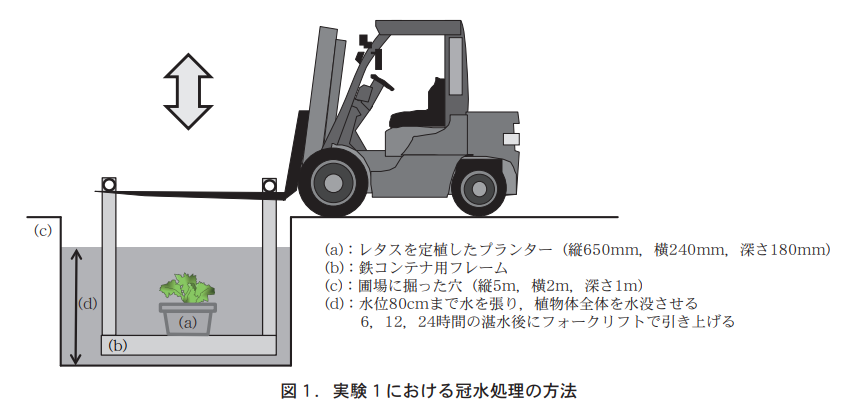
The plants were flooded at four growth stages: post-emergence (September 24: 10 days after planting, leaf age: 9), pre-pollination (October 4: 20 days after planting, leaf age: 13), early pollination (October 14: 30 days after planting, leaf age: 18), and pre-harvest (November 7: 54 days after planting, leaf age: 35). The three stages were flooded for 6, 12, and 24 hours.
収穫は11月22日に行い,冠水処理を行わなかった無処理区との地上部全重,外葉数,最大外葉長,最大外葉幅,結球重,結球内葉数,芯長(結球部から結球内葉を切除した部分の先端部から底面までの長さ) ,芯重(結球部から結球内葉を切除した部分の重さ) ,枯死株率,不結球株率,泥かみ程度(泥が付着した結球内葉数を基準に,指数0(泥の付着なし) ,指数1(結球内葉の1〜2枚に泥が付着) ,指数2(結球内葉の3〜5枚に泥が付着) ,指数3(結球内葉の6枚以上に泥が付着)の4段階で評価し,(Σ (指数×株数)/(全球数×3)) ×100で計算)を比較して,冠水処理による生育,収量,商品性への影響を評価した。灌水はホース灌水で適宜行った。
Experiment 2: Effect of urea drench treatment after waterlogging on growth and yield of lettuce
供試品種は,‘ハミングチャウ’を用いた。2013年8月21日に200穴セルトレイに播種し育苗後,9月13日に定植した。畝立ては畝幅130cm,条間30cmとし,施肥は実験1と同様である。湛水処理として,圃場内の畝間に水を入れ,水面の高さが畝地表面から3cm程度上になるまで水位を上昇させ湛水し,実験1の結果から,不結球にはならないが球肥大が不十分となった湛水時間を想定し,6時間後に落水した。
湛水処理時期は,実際の被害を想定し,台風が接近した日に行い,レタス結球前の定植後26日(10月9日,2013年台風24号の接近時,葉齢16程度)と結球初期の定植後33日(10月16日,同年台風26号の接近時,葉齢18程度)の2回の秋季強雨時に行った。湛水処理後の10月17日に湛水処理区と無処理区の畝上面から深さ5〜15cmの土壌を9か所採取し,ECの測定を行った。
湛水翌日に事後対策として,尿素の50倍液を50L・a−1株元に施用した。尿素のかん注には,シャワー状に散水するノズルを装着した動力噴霧器を用い,レタスの上部から株元に液肥を施用する方法で行った。ここで尿素を利用したのは,湛水により弱ったレタスの早期草勢回復を考えた結果,窒素単肥の中でも尿素が最も吸収効率がよく,入手しやすく,かつ水への溶解度が高く液肥が作製しやすく,湛水後の対策として実行しやすいためである。尿素を利用した湿害軽減対策はダイズ等の葉面散布などで報告されている1),2)The following is a list of the most common problems with the "C" in the "C" column.
しかし,葉面散布では1回の散布量が限られ,散布回数が増えることが問題と考え,本研究では散布量が多く,かつ短時間で処理でき,葉面からの吸収も期待できる尿素液肥のかん注処理を実施した。かん注する尿素液肥の倍率については,予備試験の中で25倍,50倍,100倍の3水準で実施した結果から,最も効果が高かった50倍を採用した。散布量については,慣行のレタス栽培における追肥1回分の窒素量に相当する0.4kg・a−1で行った。
Harvesting was conducted on November 1, and the following data were collected: total above-ground weight, tuber weight, sphere shape index, sphere area, tuber turgor, saleable sphere percentage, yield, standards (four grades: 2L (~165 mm), L (165 to 150 mm), M (150 to 135 mm), and S (135 mm and up) based on sphere diameter), and grade (sphere distortion, rise, and protrusion of midrib were evaluated on a scale of 0 to 2). The results were compared with those of the following three grades: excellent (total index of 0 to 1 and tuberosity of 0.25 to 0.35), superior (total index of 2 to 3), and A (total index of 4 to 6). The plants were irrigated with a hose using a power sprayer once immediately after planting, and no irrigation was applied thereafter. The survey was conducted in four replications of 10 plants per plot. Yield was calculated from 50 consecutive plants in each plot.
Results and Discussion
Experiment 1: Effect of timing and duration of flooding on subsequent growth and yield
Table 1 shows the effects of growth time and duration of flooding on lettuce growth and yield during the flooding treatment. Lettuce plants were greatly affected by flooding in the first half of the growth stage, after emergence and before tuberization, resulting in smaller tuber weight, core length, and core weight, and all plants died, especially in the 24-hour flooded area. On the other hand, there were no non-bulking plants in the non-flooded area. The effect of flooding on the initial stage of tuberization and the later stages of growth before harvest became smaller, but the longer the flooding time, the smaller the tuber weight compared to the non-flooded area. In the pre-harvest flooding, mud biting occurred regardless of the duration of flooding, and mud adhered to the outer fifth of the inner leaves of the tuber.
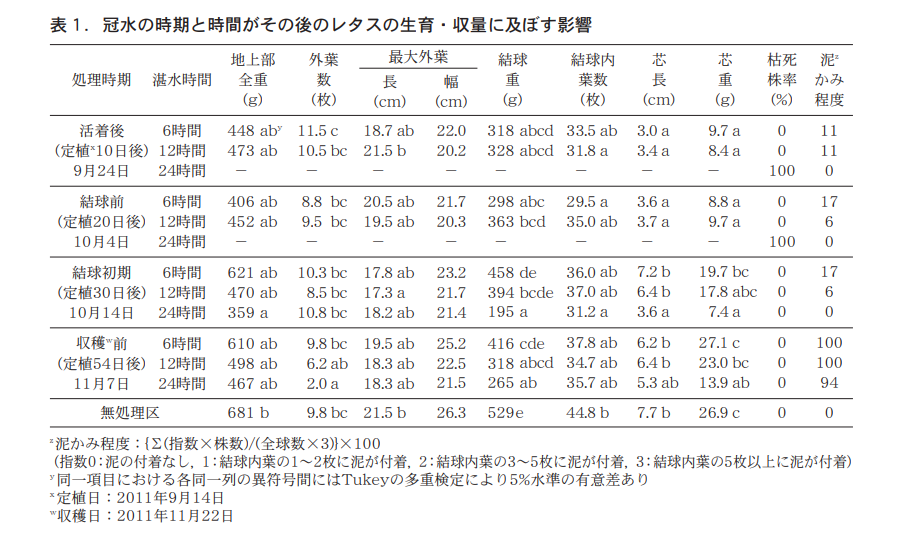
In the evaluation of the effect of flooding in planter cultivation, the non-treated area showed sufficient growth with a tuber weight of more than 500 g at harvest, and it was thought that this experimental method could be used to evaluate yield. Regarding the effect of time and duration of flooding, the 6-hour and 12-hour flooding treatments had a greater effect on the reduction of tuber weight in the first half of the lettuce growth stage (leaf age of about 13), which is after the plants are fully grown and before tuberization.
レタスは一般に窒素条件に対する生育反応が大きく,しかも早い傾向があり,生育ステージでみると施肥反応は遅くとも結球開始期までに現われるといわれており,レタスの生育制御には結球開始期までの栽培管理が重要であると考えられている3)。また,レタスの外葉には①結球体勢の維持と,②球の肥大・充実との2つの役目があるとされており,レタスにおける外葉の形成はその後の球の肥大にとって重要であるといわれている4)。本実験において,生育前半の冠水により結球重が減少したのは,冠水によりレタスの外葉形成期から結球開始期に肥料成分が十分に吸収できず外葉が形成されなかったためと考えられる。
Next, as for the effect of flooding time in the second half of growth (after leaf age 18), there was no significant difference in tuber weight between the 6- and 12-hour flooded areas in the early stage of tuberization (leaf age 18) and the 6-hour flooded area before harvest (leaf age 35), but the 24-hour flooded area in the early stage of tuberization with a longer flooding time and the 12- and 24-hour flooded areas before harvest had significantly lighter tuber weight than the untreated area. However, the 24-hour flooded area during the early stage of setting and the 12- and 24-hour flooded areas prior to harvest had significantly lower tuber weights. This may be due to the fact that the longer the flooding time, the longer the hypoxic condition in the root zone, the lower the root function, and the lower the nutrient absorption.
The effect of mud on the degree of mud penetration into the tuber was not significant, since the degree of mud penetration was 94 or higher when the crop was flooded before harvest regardless of the flooding time, whereas the degree of mud penetration was 17 or lower when the crop was flooded in the early tuber stage.
Experiment 2: Effect of urea drench treatment after waterlogging on growth and yield of lettuce
湛水処理後の尿素かん注処理がレタスの生育,収量に及ぼす影響を表2に示した。無処理区と比べ,湛水処理区の地上部全重,結球重,球体積が有意に小さく,収量も149kg・a−1と少なかった。
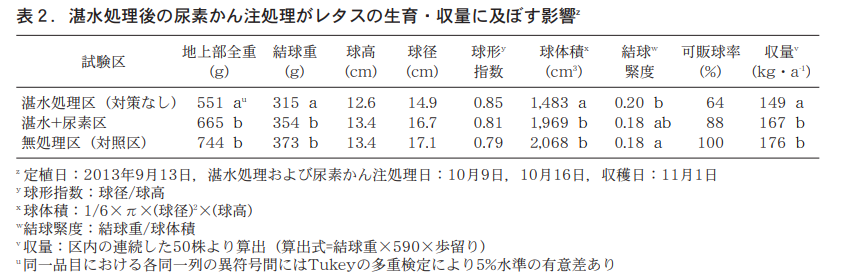
一方,湛水+尿素区では,湛水処理区と比べて地上部全重で20%,結球重で12%,球体積で33%と有意に大きかった。土壌のECを湛水処理直後の10月17日に測定した結果,湛水処理区で0.23mS・cm−1,無処理区で0.21mS・cm−1であった。
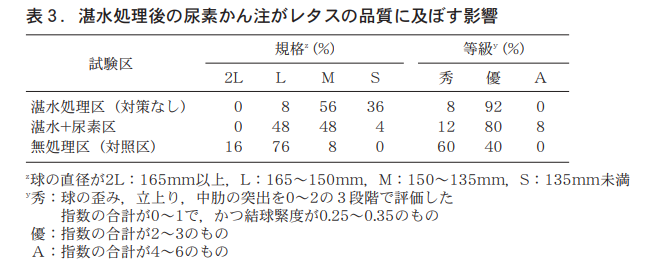
The effect of urea drench treatment after waterlogging on lettuce quality is shown in Table 3. The percentage of L or larger bulbs in the waterlogged + urea treatment (48%) was greater than that in the waterlogged treatment (8%), indicating that the bulking ability of the bulbs was recovered. The percentage of superior quality was 121 TP3T in the waterlogged + urea area, compared to 81 TP3T in the waterlogged area.
Based on the results of the planter cultivation in Experiment 1, it is considered necessary to supplement fertilizer components to further recover yield, although noncuberization does not occur if the plants are inundated for up to 12 hours during the first half of the growing season (leaf age: about 13). Therefore, in Experiment 2, we examined the effect of urea drench treatment on yield recovery.
In Experiment 2, the tuber weight and yield decreased in the waterlogged area, but recovered to the same level in the waterlogged + urea area as in the non-treated area. This is thought to be due to the fact that the injections of urea liquid fertilizer, which can be absorbed from both underground and aboveground sites, compensated for the lack of nitrogen absorption caused by the waterlogging treatment, and the vigor of the grass was restored.
また,湛水処理後の土壌ECの値から考えて,湛水処理によって土壌養分が流亡したといえるほどのECの低下はなく,土壌養分の流亡により尿素の施肥効果が強く発現したとは考えにくい。一部の株で,尿素のかん注処理直後に外葉に肥料焼けとみられる症状が認められたが,収穫時の結球部にはその症状はなく,結球内部の解体調査においても結球内葉の葉先が褐変する症状はみられなかった。湛水+尿素区で球の肥大は回復したが,球の形状が不安定で,無処理区に比べ秀品率が低下した。
これは,湛水の影響で生育が抑えられ,その後の尿素かん注処理による肥効の影響で球の肥大が急速に進んだために球の形状が乱れ,秀品率が低下したものと推察された。今後,球の形状の乱れを最小限にする施肥量についての詳細な検討が必要であると考えられる。
Summary
The results of Experiments 1 and 2 indicate that lettuce can survive up to 12 hours of waterlogging at the growth stage before tuberization (leaf age 13 to 16), and that yield recovery is possible with urea drench treatment. These results suggest that the growth stage and duration of waterlogging of lettuce can be used in production as a criterion to determine whether to replant or not.
References
1)水田転換畑におけるダイズの過湿障害 第3報 尿素の葉面散布による湿害の軽減.
杉本秀樹・ 佐藤亨・西原定照・成松克史.日作紀.58:605−610.1989.
2)Uptake of mineral nutrients from foliar fertilization (Review).
Wójcik, P. J. Fruit Ornam. Plant Res. Special ed. 12:201−218.2004.
3)球肥大充実の生理.
加藤徹.農業技術大系野菜編6.レタス サラダナ.p. 基49−58.農文協.東京.1972.
4)レタスの形態と栄養生理.
塚田元尚.農業技術大系土壌施肥編2.p.113−119.農文協.東京.1987.
The problem of thatch happening on the golf course and
CDU入り肥料の芝生サッチ分解効果試験
General Incorporated Foundation Kansai Green Research Institute
所長 森 将人
1. thatch problem on golf courses
Golf courses are maintained with a single vegetation called turfgrass, and the most extensive areas are roughs and fairways. Although turfgrass species vary from region to region, in the Kansai region, Japanese knapweed is mainly used for the roughs, and Japanese korai shiba for the fairways. Since both are Japanese turfgrasses, their stems and leaves "wither" during the winter, and the dead stems and leaves are deposited on the soil surface.
Failures that are likely to occur when thatch accumulates include reduced turfgrass activity, fertilizer and water infiltration disturbance, reduced herbicide effectiveness, and high incidence of large patch disease in areas prone to poor drainage and excessive humidity. Earthworm infestations are also more likely to occur in areas prone to excessive humidity. Earthworms are generally considered to be beneficial insects that promote soil composite structure. However, earthworm infestation on golf courses is not very desirable because large numbers of earthworms can lead to the formation of large mounds of feces, which can affect golf play and the appearance of the golf course. In addition, the areas where earthworms occur are often prone to poor drainage, but it is not clear whether earthworms increase in areas with poor drainage or whether the increase in earthworms causes poor drainage.
2. lawn death due to soil acidification
Next, as a problem caused by the increase in thatch, we will introduce a new case of thatch on a golf course. Although the area affected and the degree of damage vary from region to region, yellowing and death of Japanese grass in the roughs and fairways of golf courses has been observed from May to June (Photo 1).
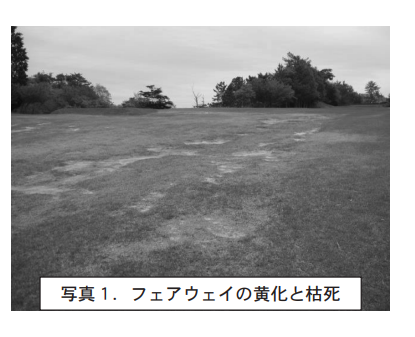
The initial symptom is irregular yellowing of both Japanese knapweed and Japanese korai shiba. Yellowing tends to occur between April and the onset of the rainy season, and often occurs in the same location every year. Several years after the onset of yellowing, the density of turfgrass clearly decreases, no new shoots appear in spring, and the turf continues to die even in summer, when it is most active in growth. Even if fertilizer is applied, the symptoms do not recover and the area of dead areas increases.
In some cases, it is not uncommon for lawns to yellow or die, and possible causes include (1) insufficient fertilizer, (2) feeding damage by lawn diseases or insects, (3) the effects of herbicides used in the fall and spring, and (4) tread pressure caused by players or maintenance equipment stepping on the turf. Although the causes can be assumed to some extent according to turf management records and the use of chemicals and fertilizers, in the golf course in the photo, the causes were different from those listed above, and the main factor was soil acidification.
(1) Causes of soil acidification
The cause of soil acidification may include mountain soils that are acidic, and tea is often grown in areas with acidic soils. The pH suitable for tea cultivation is said to be around 4.0 to 5.0, and in the Kansai region, yellowing is most likely to occur on golf courses in Kyoto and Nara prefectures. In addition, the acidification of the soil due to the accumulation of thatch on golf courses may have an effect on the growth of lawn grass.
(2) pH of dead turf area
The condition of a golf course where the turf field has died appears at first glance to be that the turf has completely died and the soil on the ground surface is bare, but organic matter such as dead turf and thatch has accumulated in the surface layer to 2 cm to 4 cm in depth (Photo 2). The dead areas are uniformly in the same condition, and digging into the surface layer reveals an accumulation of organic matter such as peat moss, which would not be present if the lawn had simply died. This is probably due to the accumulation of lawn clippings and winter dead material over the years.
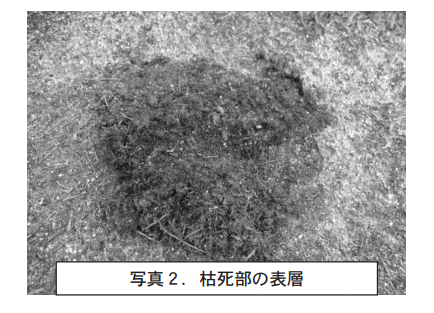
The pH of the dead area was measured to be pH 3.2 to 3.7 in the surface area with high organic matter and pH 4.0 to 4.7 in the soil below the organic matter, indicating that the soil is clearly acidic. The pH of soil suitable for turfgrass is basically neutral, ranging from pH 6.0 to 7.0, although there are some differences depending on the turf species.
(3) Methods of improving acidic soil
Even on a golf course with acid soil, it is unlikely that a turf that was green until a few years ago will suddenly die out. If acidic soil was originally the cause, problems such as the turf not establishing itself would have occurred within a few years after the turf was installed at the time the golf course was built. If there is no problem after the construction of the golf course, the yellowing and death of the turf after 20 or 30 years are caused by the accumulation of thatch over many years.
Until around 1980-1990, when the golf boom was in full swing, management budgets were available, and fairways were renewed by vertical grading and sanding once or twice a year. These operations were greatly related to the accumulation of thatch, but after 2000, management budgets tended to be reduced, and the balance that had been maintained for adequate removal and decomposition of thatch by renewal operations was lost, and the soil became acidic due to the accumulation of thatch.
酸性になった土壌を出来るだけ中性に近づける試みとして苦土石灰の処理を行ってみた。酸性の所にアルカリ性の資材を加えることで土壌を中和させることが目的である。施用量は1m2当たり20g〜100g程度を想定したが,施用を行った時期が4月下旬であることから,芝生への影響を考え20g処理とした。冬期であれば50g〜100gでも問題ないが,芝生の生育期では葉先枯れなどの症状が現れるためである。土壌pHは表層土0〜3cm,下層土3〜5cmの土壌を測定した。処理前のpHと比較して苦土石灰20g処理でもおよそ2週間後には,少しではあるがアルカリ性に近づけることが出来た。
Since the application of bitter lime is considered to have a temporary effect, we will continue to check the duration of the effect depending on the amount applied and the degree of recovery of lawn growth in order to establish an appropriate application method. If the application is made at the time of yellowing, which is the initial symptom, the effectiveness of the bitter lime can be determined by the degree of yellowing.
The countermeasure for golf courses where acid soil has led to yellowing or even death is to replace the turf around the dead areas. If the surface soil is removed and new turf is installed, there should be no problem with turf growth because the accumulated thatch is removed. However, this would be a significant loss considering that the majority of the fairways would have to be replaced while the golf course is open for business, and that a curing period would be required until the turf is established and ready for play.
3. method of confirming the effectiveness of thatch degradation
芝生を育てる中で発生するサッチの問題は無くなることはなく,むしろ今後のゴルフコース維持でも対策を講じて行かなければ大きな負の要因になることが考えられる。サッチが増えすぎた場合には様々な障害が出ることになるが,現状ではサッチが多いのか少ないのかを特定することは難しい。サッチの過多を測定する方法は確立されてはいないものの,2013年から2017年に行った緩効性窒素肥料であるCDU入り肥料のサッチ分解効果試験内の調査方法を紹介する。
(1) Method of measuring the amount of thatch in the test area
The application of a fertilizer containing CDU (Greenbase NPK) and a thatch degrading material (Bacillus subtilis) to turfgrass resulted in improved permeability and reduced occurrence of large patches. Although some adverse effects were observed, such as increased water permeability due to reduced thatch and reduced water retention, which resulted in drought damage, the fact that such positive effects were obtained is a satisfactory result.
Although this was a long-term study, it was very significant where the soil was applied over a period of years. As a final survey, soil samples were taken from each test plot and the amount of thatch was measured to verify whether the amount of thatch was reduced in the spring of 2017.
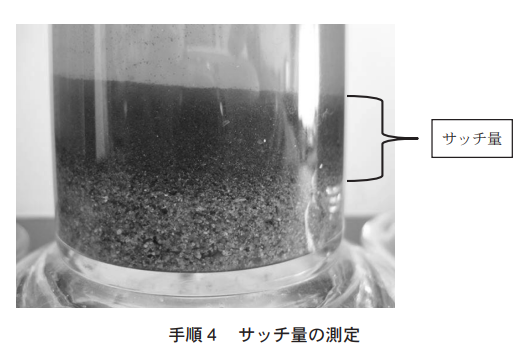
サッチ量の測定方法は以下の手順で行った。すなわち,
①小型のホールカッターで各試験区から4か所の土壌サンプルを抜き取る。
}②サンプルを容器に移し,水を加えて振とう機で60分振とうさせ,芝生の部分と土壌を分離させる。
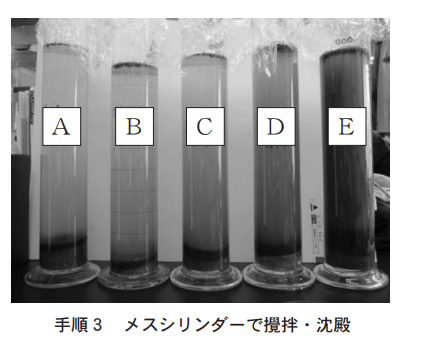
③分離した芝生は取り除き,残った土壌をメスシリンダーに移し,上下に50回攪拌させ土壌を沈殿させる。
④24時間程度沈殿させれば土壌と有機質とが分離するので,土壌の上に堆積した有機質の高さを測定しサッチ量とした。
⑤沈殿した土壌とサッチを容器に移し替え,80℃24時間で乾燥する。
⑥重量を測定後,土壌とサッチをバーナーで焼いてサッチを除去する。
⑦⑤の手順で測定した重量から焼却後の土壌の重量を引いた値をサッチ重量として測定した。
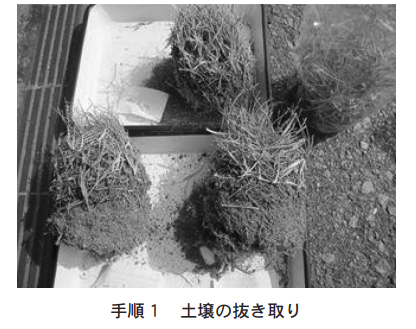
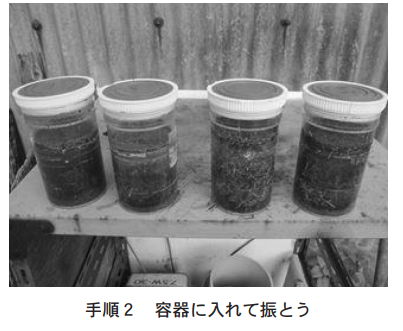
(2) Results and Discussion of Thatch Volume and Thatch Weight Measurements
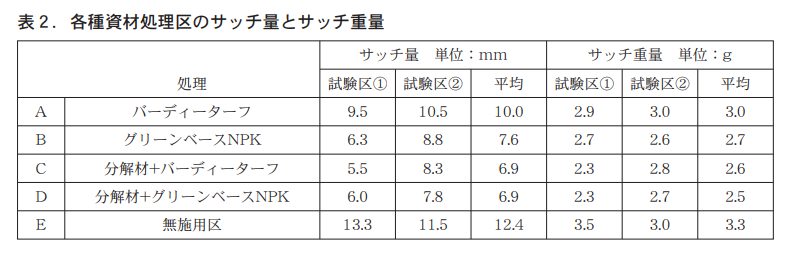
As a result of continuous biannual treatments of CDU-containing fertilizer (Green Base NPK) and thatch degrading material (Bacillus subtilis) from 2013 to 2016, it can be said that the amount of thatch showed a clear decreasing trend compared to the no-application area. Although no significant difference was observed between GreenBase NPK and thatch decomposers, it is possible that the use of GreenBase NPK alone was as effective as thatch decomposers. However, it is highly likely that continuous application will lead to a reduction of thatch.
Although the method of measuring the amount of thatch described in this article is time-consuming and labor-intensive, the amount of thatch can be estimated to some extent even up to step 4 described above as a simple method of measurement. In particular, where measurements are made with a measuring cylinder, differences often appear in the time it takes for the water to precipitate. This is because it takes a long time for the water to become clear to a certain degree after finally precipitating in soils that are considered to have a large amount of thatch. The photo in step 3, taken about one hour after stirring, clearly shows that the no-treatment area remained turbid and took longer to settle than the other treatment areas. The large number of fine, undecomposed materials is thought to be the cause of the turbidity not resolving over a long period of time. The amount of thatch should be checked at least once a year, as the increase in these substances reduces the permeability and drainage of the soil.
4. Conclusion
CDU入り肥料(グリーンベースNPK)やサッチ分解材(バチルス菌)の施用は,サッチを減らす目的として有効な手段と言える。しかし,ゴルフ場の管理予算は年々減少傾向にあることから,長期的な連続施用は難しいかも知れないが,サッチを減少させることの効果には,
①病害の発生予防になる(殺菌剤の使用量が減る) ,
②バーチカルの回数や目砂の施用量を減らせる,
③酸性土壌になることで芝生が枯れた所の張り替えや酸性土壌を中和させる資材費を減らせる,
④主に除草剤の効果が低下することを防ぐ
などが考えられる。サッチが増えることにより別途費用を掛けなければならないことを考慮すれば,CDU入り肥料(グリーンベースNPK)等の定期的な施用は決して高いものでは無いと思われる。